Wednesday, 18 November 2020

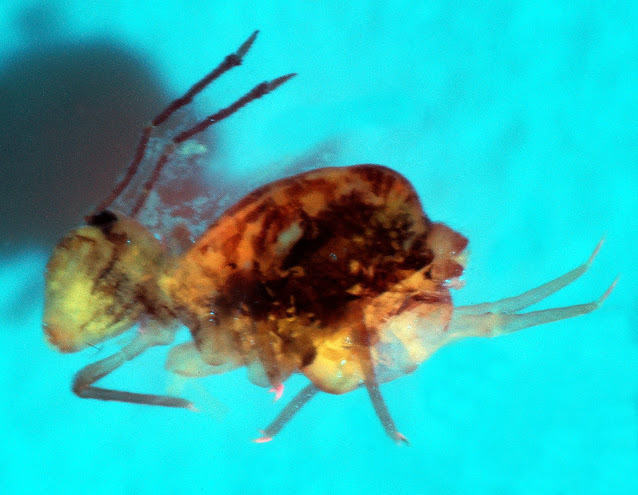
Orius vicinus (?)

A vacuum sample from streamside vegetation turned up this 2mm Anthocorid bug.

Orius vicinus


Orius vicinus

Based on the long hairs, fine punctures and transverse wrinkling on the posterior lobe of the pronotum (rather than the coarse punctures described for O. minutus), I'm pretty confident that this is Orius vicinus. However, this is a very difficult genus. This specimen shows the leg pigmentation usually described for O. vicinus, but this character is variable and not reliable (Orius (Heterorius) vicinus (Ribaut) (Hemiptera: Heteroptera: Anthocoridae) in western North America, a correction of the past. (2010) Proceedings of the Entomological Society of Washington, 112(1), 69-80). The bad news is that this specimen is a female (males do not overwinter) and my hopeful attempts to examine the bursa and copulatory tube were unsuccessful. We currently have no confirmed VC55 records for O. vicinus


Saturday, 14 November 2020

Microplastics - Into the Unknown

Plastics comprise a wide range of synthetic or semi-synthetic organic compounds, typically high molecular weight polymers. While there is no universal definition of the term microplastics, here I consider them to be fragments of plastic less than 1mm in size. There are two main classes of microplastics. Primary microplastics are any plastic fragments or particles already 1mm in size or less before entering the environment, including microfibers from clothing, microbeads, and plastic pellets known as nurdles. Secondary microplastics are microplastic particles created from the degradation of larger plastic products through natural weathering processes once they enter the environment. 

So why bother looking at microplastics? Although there is now a growing literature on microplastics in aquatic environments, less is known about terrestrial ecosystems (Rillig, M. & Lehmann, A. (2020) Microplastic in terrestrial ecosystems. Science, 368 (6498), 1430-1431), and specifically the effects of microplastics on soil mesofauna, even though there is evidence that they may negatively affect soil fauna (Lin, D. et al. (2020) Microplastics negatively affect soil fauna but stimulate microbial activity: insights from a field-based microplastic addition experiment. Proceedings of the Royal Society B, 287, 1934, 20201268). 

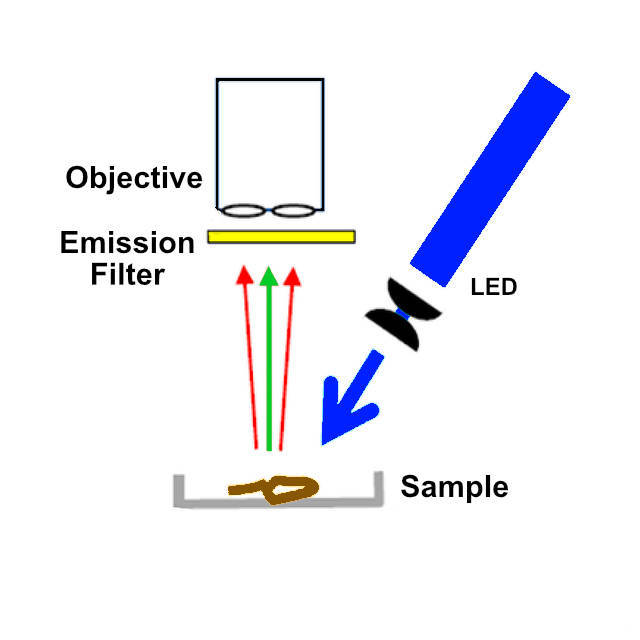
A few months ago a came across a paper with a simplified methodology for examining microplastic contamination in biological specimens (Labbe et al (2020) Inexpensive Adaptations of Basic Microscopes for the Identification of Microplastic Contamination. J. Chem. Educ. 97, 11, 4026–4032). This paper uses Nile Red to visualise microplastic particles, a lipophilic stain most frequently used to localize and quantitate lipids, particularly lipid droplets within cells (Greenspan P, et al. (1985) Nile red: a selective fluorescent stain for intracellular lipid droplets. The Journal of Cell Biology 100 (3), 965-973). Polar lipids (i.e. phospholipids) which are mostly present in membranes, are stained in red whereas neutral lipids (cholesterol and triglycerides), present in lipid droplets, are stained in yellow. Nile Red is almost nonfluorescent in water and other polar solvents but undergoes fluorescence enhancement and large absorption and emission blue shifts in nonpolar environments (excitation/emission maxima ~552/636nm in methanol). In the paper, a 1mg/ml solution of Nile Red in methanol is used to stain the particles. After staining fluorescence is visualised by illumination of the material with a blue light source and a yellow emission filter. As in the paper, I investigated using a blue laser to get maximum fluorescence but abandoned this in favour of a blue LED flashlight for safety reasons.

Optical setup

Helpfully, in the European Union most plastics intended to be recycled are labelled with a numbered code:

1 - PET (Polyethylene Terephthalate)
2 - HDPE (High Density Polyethylene)
3 - PVC (Polyvinyl Chloride)
4 - LDPE (Low-Density Polyethylene)
5 - PP (Polypropylene)
6 - PS (Polystyrene)
7 - Other Non Recyclable Plastic

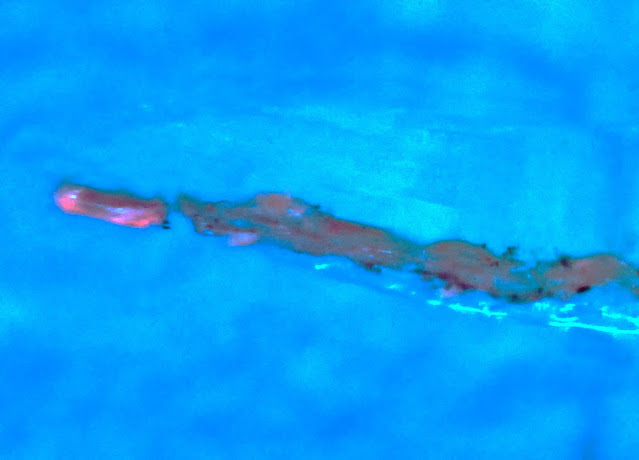
With everything in place, I began by testing on some known (from the recycling codes) plastics. Hydrophobic plastics such as polyethylene show yellow-green emission in the presence of Nile Red, while more hydrophilic plastics show red emission. Native cellulose fails to fluoresce but appears blue due to breakthrough of scattered light. A fragment of clear plastic food packaging labelled 1: R-PET (Recycled polyethylene terephthalate) showed only faint red fluorescence on some of the abraded surfaces:

R-PET

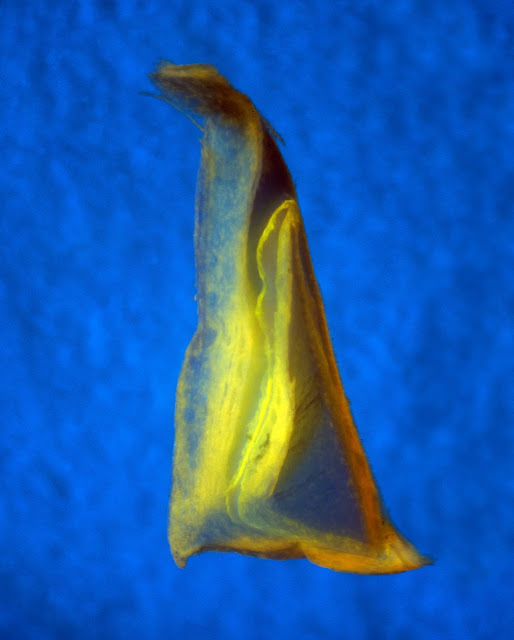
A piece of white food packaging labelled 7: Other Non Recyclable Plastic - gave a brighter yellow emission, again mostly from abraded surfaces:

7-Other

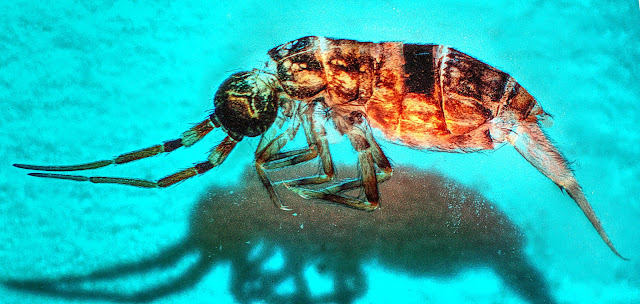
Having satisfied myself that the system was working I moved on to look at some biological materials, starting with alcohol-preserved springtails. Orchesella cincta gave a diffuse surface pattern of red fluorescence (bear in mind that these specimens are only illuminated with blue light, any other colours are due to fluorescent emissions passing through the yellow emission filter):

Orchesella cincta

Dicyrtomina saundersi also gave a faint pattern of surface fluorescence, although the claws showed strong red fluorescence:

Dicyrtomina saundersi

I then cleared some specimens of these two species with 10% NaOH and stained them after clearing. Very little fluorescence was visible in the D. saundersi but the O. cincta showed a bright pattern of surface fluorescence:

Cleared O. cincta

In none of the six specimens I examined did I detect any microplastic particles. However, these samples came from a relatively pristine environment (PAWS - planted ancient woodland sites), or at least, as pristine as it is possible to get in Leicestershire. Next I plan to look at samples from more urban environments where incidence of microplastic contamination is likely to be higher. 


Wednesday, 11 November 2020

Are spiders intelligent?

In this fascinating paper, "intelligence" is defined as flexible problem-solving capacity. So are spiders intelligent? The answer is ... sort of. The conclusion reached is that Portia, a genus of jumping spider that feeds on other spiders, is "distinctly cognitive" (able to acquire knowledge and understanding through thought, experience and the senses). That's one step short of a Gregorian creature such as a human (self-consciousness), but not bad for a spider brain.

Arthropod Intelligence? The Case for Portia (2020) 11: 568049. https://www.ncbi.nlm.nih.gov/pmc/articles/PMC7591756/

Abstract:
Macphail's "null hypothesis," that there are no differences in intelligence, qualitative, or quantitative, between non-human vertebrates has been controversial. This controversy can be useful if it encourages interest in acquiring a detailed understanding of how non-human animals express flexible problem-solving capacity ("intelligence"), but limiting the discussion to vertebrates is too arbitrary. As an example, we focus here on Portia, a spider with an especially intricate predatory strategy and a preference for other spiders as prey. We review research on pre-planned detours, expectancy violation, and a capacity to solve confinement problems where, in each of these three contexts, there is experimental evidence of innate cognitive capacities and reliance on internal representation. These cognitive capacities are related to, but not identical to, intelligence. When discussing intelligence, as when discussing cognition, it is more useful to envisage a continuum instead of something that is simply present or not; in other words, a continuum pertaining to flexible problem-solving capacity for "intelligence" and a continuum pertaining to reliance on internal representation for "cognition." When envisaging a continuum pertaining to intelligence, Daniel Dennett's notion of four Creatures (Darwinian, Skinnerian, Popperian, and Gregorian) is of interest, with the distinction between Skinnerian and Popperian Creatures being especially relevant when considering Portia. When we consider these distinctions, a case can be made for Portia being a Popperian Creature. Like Skinnerian Creatures, Popperian Creatures express flexible problem solving capacity, but the manner in which this capacity is expressed by Popperian Creatures is more distinctively cognitive.


Thursday, 5 November 2020

I've been looking for this spider for two years

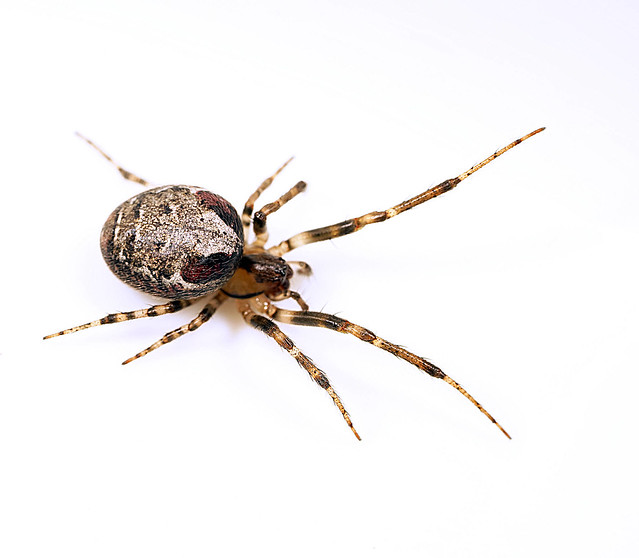
Zygiella atrica

The WSC describes Zygiella atrica as "common on the coast, rare in the mountains". We don't have coast or mountains in VC55 but there are around 100 well-distributed records for this species in the County database, so I wouldn't call it rare. In spite of that, it has managed to become a bogey species for me over the last two years. So much so that I was starting to doubt that I could identify this species correctly, that I was missing specimens as Zygiella x-notata. Tylan Berry didn't help by showing that Z. atrica grades into Z. x-notata morphologically, increasing my paranoia. Yesterday, on a pre-lockdown field trip, I was pretending a Gorse bush was Matt Hancock and giving it a damn good thrashing. As soon as this beauty hit the tray I knew immediately my wait was over. They do exist!
 

Thursday, 29 October 2020

Ants Can't Jump

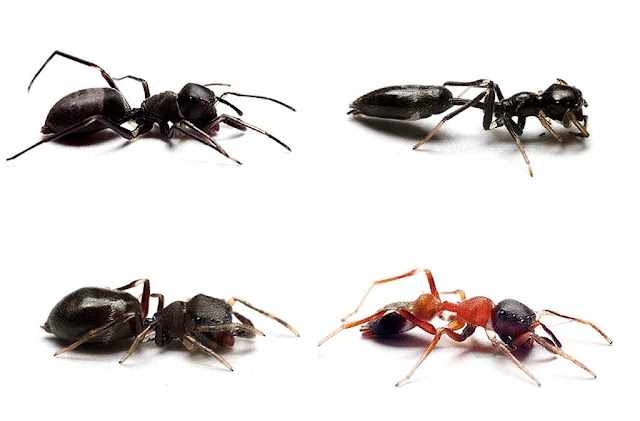
Myrmarachnes

Morphological ant mimicry by Myrmarachne [ant mimic]  jumping spiders confers strong protective benefits against predators [considered to be a good example of Batesian mimicry].

BUT: 

The ant-like appearance of Myrmarachne spiders, such as narrow and constricted body with an elongated pedicel, seems unsuitable for generating the high hemolymph pressure required for jumping. 


Constraints on the jumping and prey-capture abilities of ant-mimicking spiders (Salticidae, Salticinae, Myrmarachne). Sci Rep 10, 18279 (2020)
https://doi.org/10.1038/s41598-020-75010-y


Saturday, 10 October 2020

Tenuiphantes Top Tips

I've spent the day working though an enormous pile of Tenuiphantes tenuis. They're not only the most common spider in VC55, they're also a right pain to separate. Which is were two top tips come in.

Top Tip No. 1: Tenuiphantes or Bathyphantes?
Easy - Tenuiphantes have a proximal dorsal spine on metatarsus I, Bathyphantes don't.

Top Tip No. 2: Which Tenuiphantes species?
These are both Tenuiphantes tenuis:


With males, the palps are confusingly similar too - until you know to check the paracymbium:


No more confusion. Thanks to Tylan Berry. 


Thursday, 8 October 2020

Florodelphax leptosoma - a new planthopper for VC55

I recently picked up a useful field tip. If you're like me, there are certain species which you know well but can never remember the names of. The trick is to give them a name you can remember, then look them up when you get home. Among the hoppers (Auchenorrhyncha), the Planthoppers (family Delphacidae) are easy to assign to a family (large, apical movable spur on the hind tibiae), but mostly tricky to identify to species level. One exception is Conomelus anceps, which I find at almost every site I visit - but can never remember the name of:

Conomelus anceps

I have been able to resolve this difficult by christening them "Minions". Problem solved. 

On a recent trip to New Lount, a few small dark Minions stood out from the crowd in the tray. On examination, these turned out to be Florodelphax leptosoma:

Florodelphax leptosoma

This is a fairly common species found in a wide range of wetland habitats across the UK, but the fact that it has never been recorded previously in VC55 points to how seriously under-recorded the Auchenorrhyncha are as a group. 
 

Friday, 25 September 2020

2020 sucks - one man and his leaf blower

Cann, AJ (2020) 2020 sucks - one man and his leaf blower. Leicestershire Entomological Society Newsletter 63: p14-15.