Showing posts with label Linyphiidae. Show all posts

Monday, 27 July 2026

The Softly Singing Spider

 Cann, A. (2026) The Softly Singing Spider. British Arachnological Society Newsletter, 166, 9.

The Softly Singing Spider
click for larger image


Monday, 7 July 2025

Contradictory spider

I recently wrote about microbiome-mediated spread of the Mirid bug Apolygus lucorum. Hot on the heels of that discovery comes another - the microbiome of the invasive Linyphiid spider Mermessus trilobatus does not contribute to its dispersal and spread. 

Complicated, isn't it? 

The Microbiome of an Invasive Spider: Reduced Bacterial Richness, but no Indication of Microbial-Mediated Dispersal Behaviour. (2025) Microbial Ecology, 88(1), 70. https://link.springer.com/article/10.1007/s00248-025-02565-6


Sunday, 10 March 2024

The Return of Megalegs


Megalepthyphantes sp. near collinus

On 26th January 2022 I was refurbishing a pond in my Leicester garden when I found a single female spider which, after investigation, turned out to be Megalepthyphantes sp. near collinus. Quite a mouthful that (because it still lacks a formal description and naming), so Megalegs for short. This record was a big range expansion for this new spider. And ... that was it. I have not found any more specimens, and neither has anyone else in VC55. Until, that is, Saturday 9th March 2024, when, opening my dustbin I found another female on the inside of the lid. To find one spider may be regarded as fortunate; to find two looks like there is a colony in my garden. The bin was crammed with hedge prunings from the previous day, which is where the spider must have come from. I look forward to future sightings. 

Megalepthyphantes sp. near collinus epigyne


Thursday, 7 March 2019

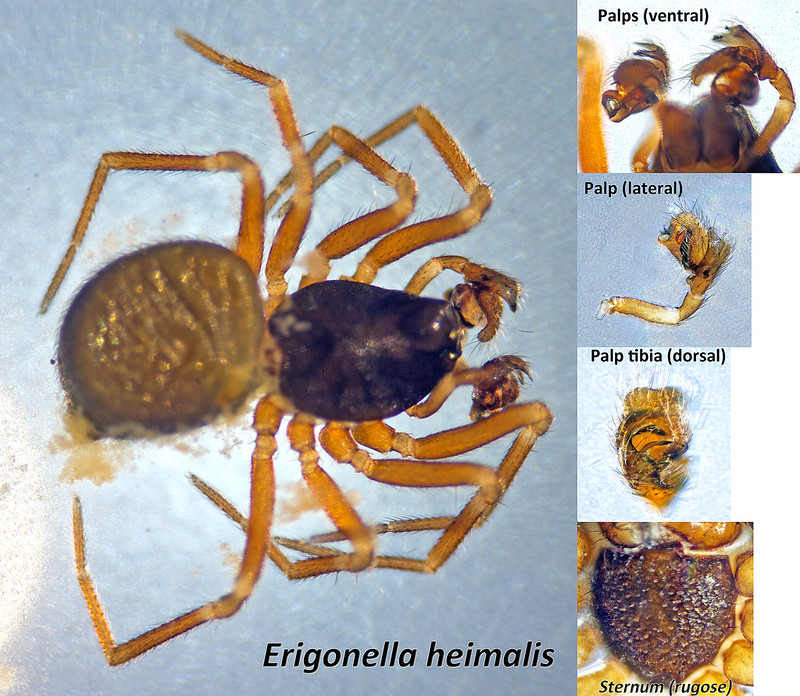
Erigonella hiemalis

Erigonella heimalis


I very much admire Australians - the fortitude they display when they know that spider in the bath can kill them - and what the Redback in the dunny is plotting, well that doesn't bear thinking about. In the UK things are different. Adult female Erigonella hiemalis can reach nearly 2 mm in length, although males like this one struggle to reach 1.5 mm. It's a dangerous life being a UK Arachnologist - think of the eye strain.

https://araneae.nmbe.ch/data/566