Showing posts with label moths. Show all posts

Saturday, 29 August 2026

What we're missing

Netelia cristata, 5th VC55 record

Netelia cristata

Over the past few years I've tried (and pretty much failed) to convince colleagues that it is a scientific and ethical imperative to at least try to analyze the bycatch from insect trapping, including but not limited to light traps. Blinded by the light (sorry, moths), I can't seem to convince people to make the effort. One notable exception is my colleague Graham who regularly sends me samples from his amazingly productive garden moth trap. Working together we have clocked up an ever growing list of new species for VC55, including many solitary wasps.

Parasitoid wasps, usually overlooked, are crucial for understanding ecosystems and environmental change. Capitalising on other projects such as the bycatch from moth trapping can provide valuable insights into these overlooked taxa at relatively low additional cost or effort. A new article describes the use of an existing citizen science project, the National Moth Recording Scheme, to monitor nocturnal parasitoid wasps in the UK. The researchers collaborated with moth-trappers to collect "bycatch" from light traps, focusing on Ichneumonidae, a family of parasitoid wasps. Over five months in 2024, they collected 6,779 specimens, representing over 184 taxa. The project successfully collected a majority of previously recorded UK nocturnal Ichneumons within the five month period (e.g. 82% of Netelia, 91% of Ophion) and provided new species records for 67 of the 71 sampled species in 82 of 91 sampled vice-counties, including some rare species.
Cunningham-Eurich, I., Aucock, L., Walters-Hutton, B., Sumner, S. & Broad, G.R. (2026) Moth traps shine a light on nocturnal parasitoid wasps: Snapshot assessment of UK diversity and distributions. Insect Conservation and Diversity, 1–23. Available from: https://doi.org/10.1111/icad.70135

Plenty of research shows the effectiveness of UV LED trapping for a wide range of insect taxa, so as soon as it stops raining I'm aiming to use my newly acquired LED strings to figure out what's flying about out there in the dark.  


See also: Dietenberger, M., Jechow, A., Sann, M., & Hölker, F. (2025) Shedding light on dark taxa: exploring a cryptic diversity of parasitoid wasps affected by artificial light at night. Scientific reports, 15(1), 6237. https://www.nature.com/articles/s41598-025-88111-3


Saturday, 22 August 2026

LED Evolution

LED Moth Trap

I've been very impressed with the LED light strip I bought recently, so much so that I decided to convert my hulking great mains-powered ALS actinic Robinson trap to LED. This was simple to do (30cm of white ABS waste pipe, another 2 metre LED strip and a few cable ties - total cost under £15. A one hour test run on a cool evening proved it works - 5 moths of 5 species but a couple of nice ones I don't see in the garden often - a Red Underwing (Catocala nupta) and a Rush Veneer (Nomophila noctuella). I'm a thorough convert to LED moth traps. 

Red Underwing, Catocala nupta


Wednesday, 26 November 2025

The Loneliest Moth in Leicester


The last couple of weeks have certainly felt like winter, which is not a bad thing - seasonality is to be welcomed. One frosty evening I was washing up after dinner when I spotted a moth on the kitchen window. Although I had never seen this species before I knew instantly what it was, which made the ensuing scramble to get a pot and catch it before it flew off even more frantic. Lonely Walter, as I called him, was a Winter Moth, Operophtera brumata. And he's definitely he/him as the females are flightless and hang around being smelly (in an alluring pheromone sort of way) and waiting for the males to find them. 

He's not the smartest looking Winter Moth you ever did see, but he is the first Winter Moth I've ever seen in our suburban garden. While Operophtera brumata is by no means a rare species, it's rare around here - there hasn't been a record within five miles in the last five years. It's also one of the moths that makes old mothers go dewy-eyed and start reminiscing about the moth snowstorm in car headlights in country lanes on winter nights. It's been a bad year for nature, with climate extremes, the Government's war on wildlife and more neighbouring gardens being stripped of vegetation, paved over and a couple of non-native plants stuck in. It would be nice to think that Lonely Walter represents a beacon of hope, and in a sense he does - Nature will find a way, etc, etc. In reality, I fear that Walter is a remnant of what we have lost. As I let him go after having his mugshot taken I wished him well, willing him to use his battered wings to find all the smelly females he dreams of. I hope he did.


Tuesday, 1 July 2025

Finishing with a bang

After what has been a tricky month, the very last night proved to be the highlight. A tropical night (according to the Met Office), and the max-min thermometer I place in my moth trap recorded a minimum temperature of 20C. And the moths responded - 247 moths of 27 species, three new for the garden - the best result I have had in years. But the moths weren't the best bit! When I turned the trap off at 3am there was a swirling cloud of life surrounding it. The by-catch comprises over 20 species of Hemiptera (which I haven't had time to sort through yet), and I didn't even attempt the Diptera or the beetles (some of which looked interesting). The absolute highlight was a species I've been waiting to see for quite a few years, the Eared Leafhopper, Ledra aurita
Eared Leafhopper, Ledra aurita

Apart from sleeping, I'd almost welcome more tropical nights.


Tuesday, 17 June 2025

The Pattern

Scarce Silver-lines, Bena bicolorana

In the past, 36 moths of 20 species in the garden moth trap on a warm June evening would have felt like a famine, but now it feels like the best I can hope for. Of these, two were new for the garden, including this Scarce Silver-lines, Bena bicolorana. This is the pattern I am seeing now - reasonable numbers of species but overall, hugely reduced numbers of insects, and diversity lower than in the past. 
 

Saturday, 17 August 2019

Moth records continue to fall

A Toadflax Brocade (Calophasia lunula) turned up in the moth trap yesterday. It was a very worn specimen, but I suspect it's come a long way. Although they've been turning up in small numbers in VC55 for the past two years I suspect this is a migrant rather than a local. Which set me thinking (on a wet day) about the County moth records.

All VC55 moth records (>68k) (to end 2018) (all data copyright Leicestershire and Rutland Environmental Records Centre, data series to end 2018):


click for larger image


I can break this down to look at VC55 moth families:


click for larger image


With over 68,000 records, this is approaching big data, so - heatmap of all VC55 moth records:


click for larger image


From the heatmap, the contributions of individual (groups of) moth recorders can be seen - as well as the remaining gaps in coverage. However, at least two of the islands point to the traditional VC55 honeypots of Charnwood and Rutland Water.


Acknowledgements:

  • All data Copyright Leicestershire and Rutland Environmental Records Centre.
  • Data visualization performed using the R platform, v. 3.6.1 (R Core Team (2014) R: A language and environment for statistical computing. R Foundation for Statistical Computing, Vienna, Austria. http://www.R-project.org).
  • J. Cann for assistance with data visualization.


Monday, 15 July 2019

Sledgehammer to crack a nut

I find it very difficult to distinguish between The Uncertain (Hoplodrina octogenaria) and The Rustic (Hoplodrina blanda). Everyone I speak to has a difference favourite method to tell them apart, but the shinyness of The Rustic compared with the rougher appearance of The Uncertain is a consistent suggestion. Unfortunately, most people agree that this character is very difficult to capture in a photo, although I think I've just about managed to capture the shinyness on the forewing in a photo (same lighting):


I took a closer look under the microscope at the scales in the kidney mark on the forewing and it is possible to see a difference - The Uncertain has quill-like scales which point forward and presumably contribute to the rough appearance, whereas the scales on The Rustic have a flatter and more "sleek" appearance:


I'll look at some more specimens as I get them and see if this is a consistent observation.

Saturday, 30 March 2019

Orange Underwing - Archiearis parthenias

Orange Underwing - Archiearis parthenias


I'd planned to go out to Pickworth Great Wood today, and that fact that an Orange Underwing was recorded there yesterday didn't put me off. On entering the wood you stand with one foot in VC55 and the other in VC53, and the first thing I saw on the path was an Orange Underwing (definitely on the VC55 side!). Much fumbling with camera and swearing, by which time it had flown off. By the end of the day though we'd seen plenty - I stopped counting at 20. Plus too many Brimstone and Peacock butterflies to count, three Commas and two male Orange Tips.


Friday, 1 March 2019

Common Quaker, Orthosia cerasi

Common Quaker


My first moth of the year. It's been hard work getting this one.

Thursday, 3 January 2019

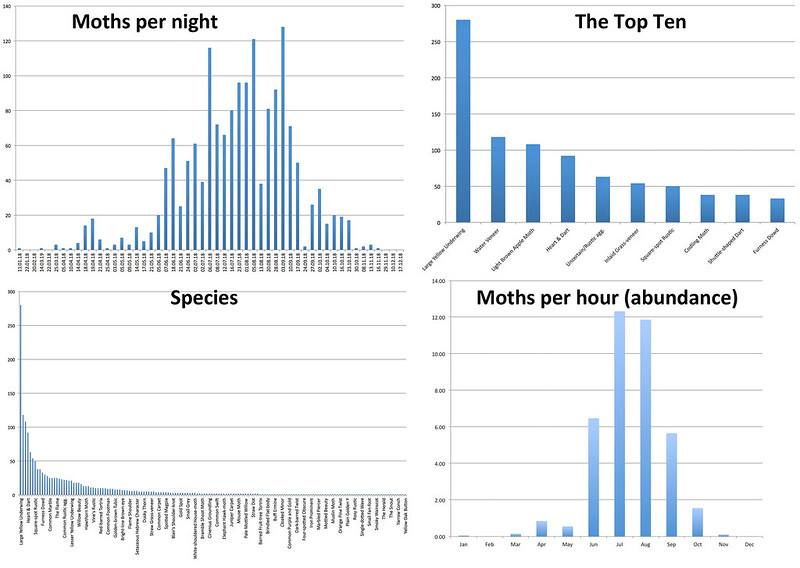
2018 - The Year in Moths

2018 - The Year in Moths

Click for larger image

1646 moths of 160 species, that's what my suburban garden managed in 2018. The year got off to a very slow start (remember all the snow?), nothing much at all until April. It really kicked off in June and the summer was notable for the number of migrants. I would have said Heart and Dart got the top slot, but the Large Yellow Underwings arrived late and then put in their normal dominant performance. Nearly all the Water Veneers arrived in three nights. The autumn was disappointing for me and I only trapped twice in December, not having seen a moth since the 16th November it just didn't justify the electricity.

It's temping to try a direct comparison with 2017 (923 moths of 108 species), but that's rather complicated. I changed my trapping equipment in May 2018 so direct comparisons are inevitably misleading, but for what it's worth:

2017 - The Year in Moths


Saturday, 30 December 2017

2017 - The Year in Moths

I've spent a couple of days wrangling my moth data for my annual return to the Country Recorder. Excel aside, it's been a very pleasurable pastime, revisiting old friends from the year past. 2017 was a difficult year and one I'm keen to move on from, but moth trapping was definitely one of the highlights, although circumstances made it impossible to trap as regularly as I wanted to. Most of all, looking back has made me eager to get on with 2018 - I'm really looking forward to it now. Data wouldn't be data without lots of nerdy graphs, so here they are.

Overall, I caught (and released) 923 moths of 108 species (including aggs). I started trapping in May and managed to trap for a total of 39 sessions (from as little as one hour but mostly all night), less than my target of once a week. Must do better next year. Although I pick my weather and only trap on favourable nights, I only had one blank, on 23.11.17. August was the peak month (320 moths), with 126 moths on 26.08.17 being my busiest night (more about that one later). Normalizing the data by trapping effort (moths per hour) doesn't change the pattern that much, although the July dip (which is very clear in my memory) becomes clearer. The species distribution is much as expected, a paretto (long tail) curve. My streetlit suburban garden doesn't produce anything unusual although I'm sure there are a few micros in there that I missed. If you'd asked me I would have been fairly confident that the most frequent moth was the Light Brown Apple Moth, Epiphyas postvittana (n = 82) - the first moth I caught in May and the last in December, a pretty constant presence apart from a midsummer dip. But I'd have been wrong about that. With a much shorter flight period, the Large Yellow Underwing, Noctua pronuba (n = 318) is the mahoosive winner, with 84 out of 126 moths on my busiest night of 26.08.17.

And my favourite moth of the year? The next one.