Saturday, 21 October 2023

The "truth" about the false widow


Steatoda nobilis

This paper looks at the origins and spread of Steatoda nobilis, some dodgy arachnology from the Revd. Octavius Pickard-Cambridge, and concludes that the reason for its rapid range expansion is ... unknown (but it's not climate change). 

Steatoda nobilis, a false widow on the rise: a synthesis of past and current distribution trends. (2019) NeoBiota, (42). https://doi.org/10.3897/neobiota.42.31582

Abstract: 

The Noble False Widow, Steatoda nobilis (Thorell, 1875) (Araneae, Theridiidae), is, due to its relatively large size and potential medical importance, one of the most notable invasive spider species worldwide. Probably originating from the Canary Islands and Madeira, the species is well established in Western Europe and large parts of the Mediterranean area and has spread recently into California and South America, while Central European populations were not known until 2011.

We report on long-time observations that reveal that at least two flourishing populations in Germany (Cologne) have been present for over five years, while in Ecuador one population has been observed between 2014 and 2018 and several other records were made in other parts of the country. Data obtained from the British Spider Recording Scheme demonstrate that the species moved significantly northwards since the report of the first populations in the very South of England, after several decades of relative stasis. The sudden northward expansion highly correlates with a massive rise in press coverage of the species.

In the Americas, S. nobilis is currently known from four countries (USA, Chile, Ecuador, Colombia), and available DNA barcoding data obtained for specimens from this area suggest that multiple introductions occurred within each country. Using ecological niche modeling, we identified suitable climate regions for the species and discuss possible reasons for its current spread. We propose that seaside cities and villages with a temperate oceanic or Mediterranean climate are especially favourable potential habitats for S. nobilis and will face the highest colonization pressure in the future, while tropical upland regions with temperate climates are also vulnerable to invasion by S. nobilis.


Friday, 6 October 2023

Bionic Spider Silk

High-strength and ultra-tough whole spider silk fibers spun from transgenic silkworms. Matter: 6, 10, P3661-3683, (2023). 

Summary: "To advance ecological civilization, developing sustainable, eco-friendly high-strength and ultra-tough alternatives to non-sustainable synthetic fibers, such as nylon, is crucial. This necessitates a deeply scientific understanding of the fundamental determinants of fiber strength and toughness, as well as overcoming engineering challenges for cost-effective, large-scale production of high-performance silk fibers. Inspired by the mechanical properties of polyamide fibers, including nylon and Kevlar, we employed CRISPR-Cas9-mediated gene editing to successfully synthesize whole polyamide spider silk fibers from transgenic silkworms. These fibers exhibited impressive tensile strength (1,299 MPa) and toughness (319 MJ/m3), surpassing Kevlar’s toughness 6-fold. Thus, they offer promising potential as sustainable alternatives to synthetic commercial fibers. Furthermore, our research provides valuable insights into the fundamental essence of fiber toughness and tensile strength, challenging the conventional notion that these properties are contradictory. These findings have significant implications for guiding the production of synthetic commercial fibers that simultaneously possess high strength and ultra-toughness."

https://doi.org/10.1016/j.matt.2023.08.013


Sunday, 6 August 2023

Hunting the Grail - one gall at a time

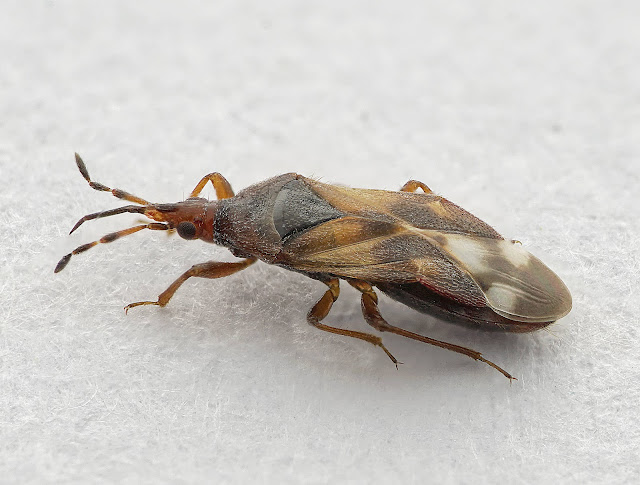
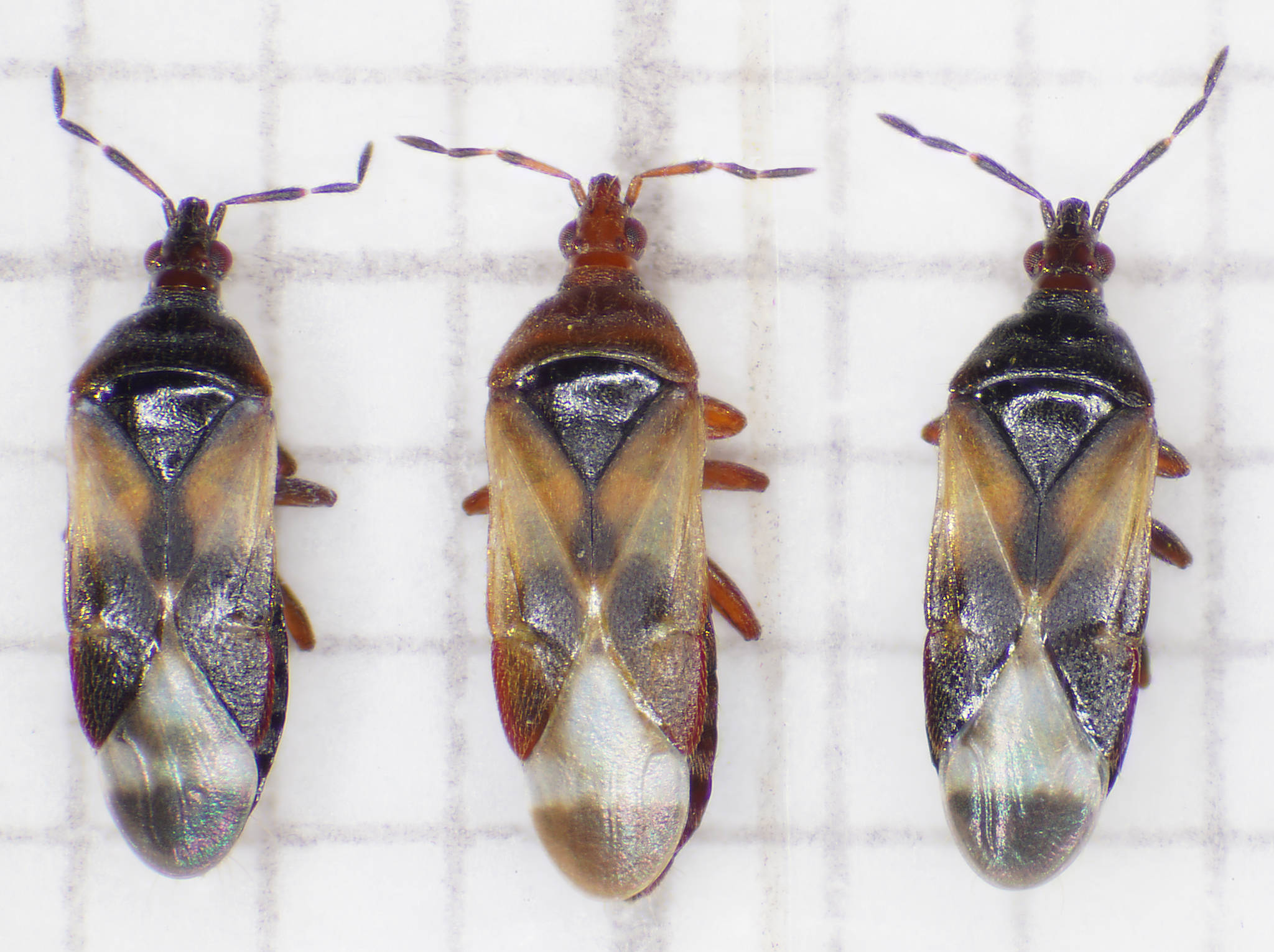
A new species of flower bug joins the VC55 list.

Anthocoris minki
Anthocoris ("flower seed") minki (after Wilhelm Mink, 1807–1883, German entomologist who collected the type specimen)

For the past year the VC55 Bug Team has been hunting down the gaps in our Anthocoris list. Apart from general under-recording, some of these are hard to understand apart from the difficulties of identifying the species in this genus. Back in January we ticked off Anthocoris butleri and put a few dots on the map, but then we ran out of Box, the host plant, and had to stop. 

Earlier in the year I had checked spiral petiole galls on Poplar trees without success but they have now matured and this week my colleague was able to make the first VC55 record for Anthocoris minki (shown above). This species is dependent on Pemphigus aphids such as Pemphigus spyrothecae and develops entirely within the aphid-caused galls. 

Pemphigus spyrothecae

By collecting tightly closed galls and opening them indoors, contamination with other Anthocoris species is avoided although of course the I.D. still needs to be checked carefully. That would be easier to do if we could find a male, but to date all the VC55 specimens found have been female. To date we have found Anthocoris minki at four different sites (not bad for a weeks work) - and now, we have just about run out of Poplar, which is not common in VC55 and as an ornamental planting, even more poorly recorded. To date, I have found: 

Site 1: 54 galls examined, 1 adult found (2% occupancy). 
Site 2: 100 galls examined, 1 adult, 1 nymph, 1 shed found (3% occupancy). 
Site 3:  90 galls examined, 4 adults, 2 nymphs found (6% occupancy). 
Overall: 4% occupancy. 

If you're concerned about some idiot collecting this number of galls, these are large trees and the number collected is far less than 1% of those present on any one tree. All the bugs have been found in separate galls. Whether this is because the females lay one egg per location or because more than one bug per gall inevitably results in early stage cannibalism I don't know. 


Anthocoris minki nymph

Strictly speaking I couldn't swear that the nymphs are Anthocoris minki without rearing (not easy to do as they live in closed galls - Schrödinger's nymphs - but since they are in closed galls, good enough). 

So what is the Anthocoris Holy Grail? Rob Ryan has documented finding a complete set of shed skins within a gall representing every instar of development. So far I have found one shed, and that's not easy with all the horrid aphid crap within the galls (I don't like aphids), but hey, 20% of the Grail for a week's work isn't a bad haul. 

shed skin
Shed skin found in a gall

A week in and I'm drowning in Anthocoris minki, but starting to wonder if males exist...

Anthocoris minki


Many thanks to Jim Flanagan and my colleagues for helpful discussions.

 Sources: 

Péricart J. (1972) Hémiptères Anthocoridae, Cimicidae et Microphysidae de l'Ouest paléarctique. Faune de l'Europe et du bassin méditerranéen, vol 7. Bulletin de la Société entomologique de France, 78(9), 337-338. https://www.persee.fr/docAsPDF/bsef_0037-928x_1973_num_78_9_29150_t1_0337_0000_2.pdf


Sunday, 16 July 2023

"Can this insect be identified?"

"Can this insect be identified?"

The Answer is: "It depends."  

Some species are unmistakable and can always be safely identified.  But for the majority, leaving aside data quality (specimen condition, photo quality, estimated sizes), specimens vary.  In some cases being able to see a certain key feature always works, no matter the size, shape or colour.  For other species, intermediate or atypical specimens cannot be safely identified.  The choice then is simply to pretend you never saw them, to record at genus level, or to record as Genus c.f. species.  In other words, it is not possible to safely identify every specimen. 

Annoying, isn't it?


Thursday, 29 June 2023

The Amazing Colour Changing Bug

Amblytylus nasutus

We have very few records for Amblytylus nasutus in VC55 (Leicestershire & Rutland). The species seems to be expanding its range and records have been coming in steadily for the last couple of weeks. I took this specimen in Rutland this week and at first I was unsure of the ID because of the black marks on the pronotum (other species of Amblytylus are available!). The answer seems to be that this is a male, male Mirids often being more vividly marked than females. However: 

Amblytylus nasutus

On being left in a pot (in the dark) overnight, by next morning the black marks had virtually disappeared. Just to confirm nothing funny was going on, I checked the aedeagus: 

Amblytylus nasutus aedeagus

Yup, bona fide Amblytylus nasutus. Ladies and Gentlemen, I give you the amazing colour changing bug. 


Friday, 9 June 2023

Monitoring and Benchmarking Insects

Useful paper with a comparison of entomological methods for surveys. Marred only by the fact that it fails to consider spiders! 

Montgomery, G. A., Belitz, M. W., Guralnick, R. P., & Tingley, M. W. (2021). Standards and best practices for monitoring and benchmarking insects. Frontiers in Ecology and Evolution, 513. https://doi.org/10.3389/fevo.2020.579193

"Benchmark studies of insect populations are increasingly relevant and needed amid accelerating concern about insect trends in the Anthropocene. The growing recognition that insect populations may be in decline has given rise to a renewed call for insect population monitoring by scientists, and a desire from the broader public to participate in insect surveys. However, due to the immense diversity of insects and a vast assortment of data collection methods, there is a general lack of standardization in insect monitoring methods, such that a sudden and unplanned expansion of data collection may fail to meet its ecological potential or conservation needs without a coordinated focus on standards and best practices. To begin to address this problem, we provide simple guidelines for maximizing return on proven inventory methods that will provide insect benchmarking data suitable for a variety of ecological responses, including occurrence and distribution, phenology, abundance and biomass, and diversity and species composition. To track these responses, we present seven primary insect sampling methods—malaise trapping, light trapping, pan trapping, pitfall trappings, beating sheets, acoustic monitoring, and active visual surveys—and recommend standards while highlighting examples of model programs. For each method, we discuss key topics such as recommended spatial and temporal scales of sampling, important metadata to track, and degree of replication needed to produce rigorous estimates of ecological responses. We additionally suggest protocols for scalable insect monitoring, from backyards to national parks. Overall, we aim to compile a resource that can be used by diverse individuals and organizations seeking to initiate or improve insect monitoring programs in this era of rapid change."


Tuesday, 9 May 2023

'Tis Psallus Time, Tra-la-la-la-la

Excuse the Fakespeare subject line, but if you fancy a challenge, it's time to get out there beating the trees for Psallus spp. 

Psallus wagneri

Colourful and common, many of the species in the Family Miridae are often a tricky to identify. The genus Psallus possibly is possibly the most challenging group. We are about to be swamped by the annual deluge of Psallus species, but these oh so common and under-recorded bugs can be identified with a bit of effort. There are 23 species on the UK Checklist:

Psallus albicinctus, Psallus anaemicus, Psallus ambiguus, Psallus assimilis, Psallus betuleti, Psallus confusus, Psallus falleni, Psallus flavellus, Psallus haematodes, Psallus helenae, Psallus lepidus, Psallus lucanicus, Psallus luridus, Psallus mollis, Psallus montanus, Psallus pardalis, Psallus perrisi, Psallus pseudoplatani, Psallus quercus, Psallus salicis, Psallus variabilis, Psallus varians, Psallus wagneri.

The Leicestershire and Rutland (VC55) list currently stands at nine species. Some of these can be tentatively identified from (detailed) habitus photos (see notes below). However, the truth is that most require dissection of the male aedeagus for confident identification. So how to tackle these common bugs? Here are my tips:

  • General guide to the genus Psallus: Arboreal Mirid species, length = 3-5mm. (Suggestion - if you can't confidently identify bugs as members of the Miridae, save yourself the pain and start by practicing on easier genera). Antennae long; second antennal segment slender, in males wider, as long as or slightly longer than posterior width of pronotum; third antennal segment two thirds the length of second segment; head of male smaller than that of female; eyes of male, in profile, covering head entirely; rostrum reaching the middle of venter, first segment reaching the middle of the xyphus; tarsal segments slender; third segment of the hind tarsus shorter or scarcely longer than the second segment and noticeably shorter than the first and second segments combined. If ant1 black then length >4mm. With a little practice you get pretty good at recognizing the genus on sight. 
  • Beating tree foliage from late spring-autumn is the way to find Psallus. The host species is often helpful, so note this. Psallus picked up from random sweeping etc are harder to get to grips with. 
  • Top Tip: Find a male and dissect the aedeagus! With a couple of exceptions that can be done from habitus, dissection is required. In theory females can be identified, but with a couple of exceptions I don't bother - it's too hard! I am happy to receive male specimens from VC55 for confirmation if you don't fancy doing this yourself. 

Resources: 

Bernard Nau's draft 2012 key to the Miridae is very good and has useful (if tiny) drawings.

Denise Wyniger's Doctoral dissertation from the University of Basel is the best resource available, but it does cover all European species and is a bit overwhelming at first. The aedeagus drawings are particularly useful: Wyniger, D. (2004) Taxonomy and phylogeny of the Central European bug genus Psallus (Hemiptera, Miridae) and faunistics of the terrestrial Heteroptera of Basel and surroundings (Hemiptera). Available at: https://edoc.unibas.ch/79/


VC55 species and notes:

Psallus ambiguus - Length >4.4mm. Ant1 black, ant3 straw, A2 black with basal half straw in ♀, ♂ dark red-brown to black, ♀ red to reddish-black. On a range of deciduous trees.

Psallus betuleti - Length 5.1mm. Upperside black; cuneus dusky with base broadly pale, outer margin narrowly reddish. Apical process of aedeagus elongate, slender, underside almost straight. On Birch. 

Psallus falleni - Length 4mm. Brownish-red, cuneus broadly white at base (white>hind tibia thickness) & very narrowly white at apex. July-September, mainly on Birch. 

Psallus flavellus - Length 3.8mm. Orange-red.

Psallus lepidus - Length 4.1mm. ♂ dark red-brown to black, ♀ red-brown to orange-brown.

Psallus luridus - Length 4mm. Upperside & antennae drab, yellowish-grey or grey-brown, dark spot on corium towards apex; dual pubescence, dark & pale. Brown points on pronotum and inner face of ant1. Femora with black spots, apex reddish. Tibia with dark spines in black spots. Head large, with long gula (throat). On Larch. 

Psallus perrisi - Upper black to black-brown, at most a slight reddish tinge, ♂  blacker than ♀; femora blackish. c.f. P. wagneri, aedeagus required. 

Psallus varians - Length 4.1mm.  Claws evenly curved; on Oak. 

Psallus wagneri - Upper dark red to dark yellowish-brown, femora dark red. c.f. P. perrisi, aedeagus required. 

 Good hunting! 


Update: Psallus perrisi vs Psallus wagneri

Arto Muinonen commented on the British Terrestrial Bugs Facebook group.  Muinonen's aedeagus drawings are similar to that of Wyniger, D. (2004).  Both of these are quite different to Nau's drawings, so I've reached that conclusion that all but one of the Leicestershire specimens to date are in fact Psallus perrisi. Muinonen also commented that P. perrisi is more frequent than P. wagneri in Finland, and my findings seem to confirm this. Now it gets complicated!  Muinonen has unpublished DNA work which agrees with Wyniger that perrisi and wagneri are synonyms and that differences in the aedeagus are intraspecific variation.   Oh dear! 


Thursday, 4 May 2023

Can insects feel pain?

It depends how you define pain...

Gibbons, M., Crump, A., Barrett, M., Sarlak, S., Birch, J., & Chittka, L. (2022). Can insects feel pain? A review of the neural and behavioural evidence. Advances in Insect Physiology, 63, 155-229. https://www.sciencedirect.com/science/article/abs/pii/S0065280622000170

"The entomology literature has historically suggested insects cannot feel pain, leading to their exclusion from ethical debates and animal welfare legislation. However, there may be more neural and cognitive/behavioural evidence for pain in insects than previously considered. We use Birch et al.’s (2021) eight criteria for sentience to critically evaluate the evidence for pain in insects. We assess six orders (Blattodea, Coleoptera, Diptera, Hymenoptera, Lepidoptera, and Orthoptera) in at least two life stages (adult and first instar juveniles, as well as other instars where relevant data are found). Other insect orders have not received enough research effort to be evaluated. According to the Birch et al. framework, adult Diptera (flies and mosquitoes) and Blattodea (cockroaches and termites) satisfy six criteria, constituting strong evidence for pain. Adults of the remaining orders (except Coleoptera, beetles) and some juveniles (Blattodea and Diptera, as well as last instar Lepidoptera [butterflies and moths]) satisfy 3–4 criteria, or “substantial evidence for pain”. We found no good evidence that any insects failed a criterion. However, there were significant evidence gaps, particularly for juveniles, highlighting the importance of more research on insect pain. We conclude by considering the ethical implications of our findings where insects are managed in wild, farmed, and research contexts."


Friday, 28 April 2023

Bad Bees!


 Gail MacInnis, Etienne Normandin, Carly D. Ziter. Decline in wild bee species richness associated with honey bee (Apis mellifera L.) abundance in an urban ecosystem. PeerJ, 2023; 11: e14699 https://peerj.com/articles/14699/