Saturday, 4 February 2023

Not the bee's knees

You may have seen the wildlife documentary "My Garden of a Thousand Bees", wildlife cameraman Martin Dohrn's 2020 Covid lockdown project.  If you haven't seen it, Google it and try and track it down - it's the best wildlife documentary I've seen for years, certainly since before the BBC gave up on anything that is not characteristic megafauna. And if that doesn't give you enough food for thought, read this:


MacInnis G, Normandin E, Ziter CD. 2023. Decline in wild bee species richness associated with honey bee (Apis mellifera L.) abundance in an urban ecosystem. PeerJ 11:e14699 https://doi.org/10.7717/peerj.14699


Thursday, 5 January 2023

Lygus - bad news for bug-bothers

The genus Lygus isn't getting any easier. 

Lygus pratensis

My very first record for 2023 is this Mirid bug sifted from Oak leaf litter. There are five species of Lygus on the UK checklist, L. maritimus, L. pratensis, L. punctatus, L. rugulipennis and L. wagneri. A typical Lygus ("smooth") pratensis ("of the meadows", so "Smooth Meadowbug") is easy to spot - shinier in overall appearance than the other members of the genus and with a single stripe on the scutellum (if present). Ah, there we have it - "if present". For Lygus is a notoriously variable genus, and quite frankly, often a pain to identify. This specimen appears to be an easy one, a nailed-on pratensis (but for the record, I did check the pubescence on the cuneus). But am I being over confident - is there more to Lygus than meets the eye? The degree of variability in this genus is worrying - does it signify hidden genetic diversity which conflicts with the current taxonomy? Are there a bunch of cryptospecies lurking in the leaf litter?

It's not just me that worries about this. A 2020 paper describes conflicts between DNA barcoding and species identification, although this partly arises from historic mis-identification of specimens rather than true taxonomic problems (Piemontese et al, 2020). In addition, a more recent paper (Namyatova et al, 2022) also suggests that DNA analysis does not agree with morphologically delimited Lygus species. 

The cynical old bug-botherer (or cynical old bugger, if you prefer) in me is happy to blame the taxonomists for this mess. As a dyed in the wool lumper I'm happy to blame the splitters for these problems. But that doesn't solve the problem - identifying Lygus species reliably is not going to get any easier. It's an "interesting" way to start the new year. But things can only get better - can't they? 


References:

Namyatova, A. A., Tyts, V. D., & Bolshakova, D. S. (2022) Identification and delimitation of the trans-Palearctic Lygus species (Insecta: Heteroptera: Miridae) using integrative approach. Insect Systematics & Evolution, 1(aop), 1-47. https://doi.org/10.1163/1876312X-bja10035
Abstract: Lygus (Insecta: Heteroptera: Miridae) is a Holarctic genus, and some of its representatives are important pests. Determining the Lygus species identity and their interrelationships is challenging. Our study aimed to delimit five trans-Palearctic species of this group: L. gemellatus, L. pratensis, L. punctatus, L. rugulipennis and L. wagneri. We implemented analyses of morphological characters, morphometrics, cytochrome c oxidase subunit I (COI) and 16S rRNA sequences. The results showed that those species could be delimited using morphology and most species pairs were different in morphometrics. Both COI and 16S rRNA were useful for species identification. Resulting phylogenetic trees contained two highly supported clades. One clade included species known from the Palearctic only, the other clade contained species with Nearctic and Holarctic distribution. Species were mostly poorly supported or non-monophyletic. Molecular species delineation approaches yielded results that generally did not correspond to the morphologically delimited species.

Piemontese, L., Giovannini, I., Guidetti, R., Pellegri, G., Dioli, P., Maistrello, L., & Cesari, M. (2020) The species identification problem in mirids (Hemiptera: Heteroptera) highlighted by DNA barcoding and species delimitation studies. The European Zoological Journal, 87(1), 310-324. https://doi.org/10.1080/24750263.2020.1773948


Thursday, 29 December 2022

2022 - My Year in Spiders

 I would sum up 2022 as quality over quantity...

2022 Spiders

I haven't been able to spend as much time as I would have liked on spidering this year, but I'm still pretty pleased with the outcome. The weather has been challenging with alternating exceptional droughts, rainfall and the highest temperature ever recorded here. Although the number of specimens I recorded was well down, I managed to make some nice finds. Here are my highlights.


Megalepthyphantes sp. near collinus

Megalepthyphantes nr collinus

The year started well in January when I was refurbishing an old garden pond into a bog garden and found a specimen of Megalepthyphantes sp. near collinus which I eventually managed to identify with help, a horticultural import I suspect and the first record for VC55.


Leptorhoptrum robustum

Leptorhoptrum robustum
This Linyphiid turned up on a streamside survey in March as part of a local river restoration project, one of two projects to which I have devoted field time this year. An inhabitant of the local sewage works, these spiders work their way downstream and I have found them at several places along the watercourse, showing just how much restoration is needed.


Mastigusa macrophthalma

Mastigusa macrophthalma
I "refound" the "Charnwood Spider" in VC55 after a gap of twenty years as part the other large landscape project I have been contributing to this year. The first specimens turned up in March at one of the species strongholds, but I was subsequently able to find it at another site where it had never been recorded. More importantly, I was able to confirm that it was not present (following on from decades of arachnological work) at quite a few other sites which look eminently suitable but where it is just absent. I only recently worked out why this is, so I think this quest will be continuing next year.


Textrix denticulata

Textrix denticulata
This attractive spider was a by-product of searching for Mastigusa. This species is not common in VC55, or at least it is not commonly recorded, but I found it at a number of different locations, partial compensation for drawing a blank with Mastigusa on most field trips.


Mangora acalypha

Mangora acalypha

This orb-weaver has only spread to VC55 very recently and the few records have been from a garden so it was a pleasant surprise to find it on Gorse in a rural location. This one is clearly on the move. 


Arctosa leopardus

Arctosa leopardus
I found this attractive wolf spider in a riverside sample in May when I was desperately targeting damp places after the spring drought. Much of my time this year has been taken up slogging though hundreds of pitfall trap samples from a large 2021 survey at Rutland Water which turned up several specimens of this species - the first records for VC55. My specimen came from the opposite side of the vice-county, so it is clearly established on different drainages and it is strange that this species has not been recorded before.


Collinsia distincta


Collinsia distincta

This Linyphiid came from the same riverside sample as Arctosa leopardus, making this a productive trip. The first record for VC55 for this species.


Lophomma punctatum

Lophomma punctatum

As if two weren't enough, the same sample also produced a specimen of Lophomma punctatum. This spider is well known from the County but not often recorded so it was a nice addition.


Oonops domesticus

Oonops domesticus

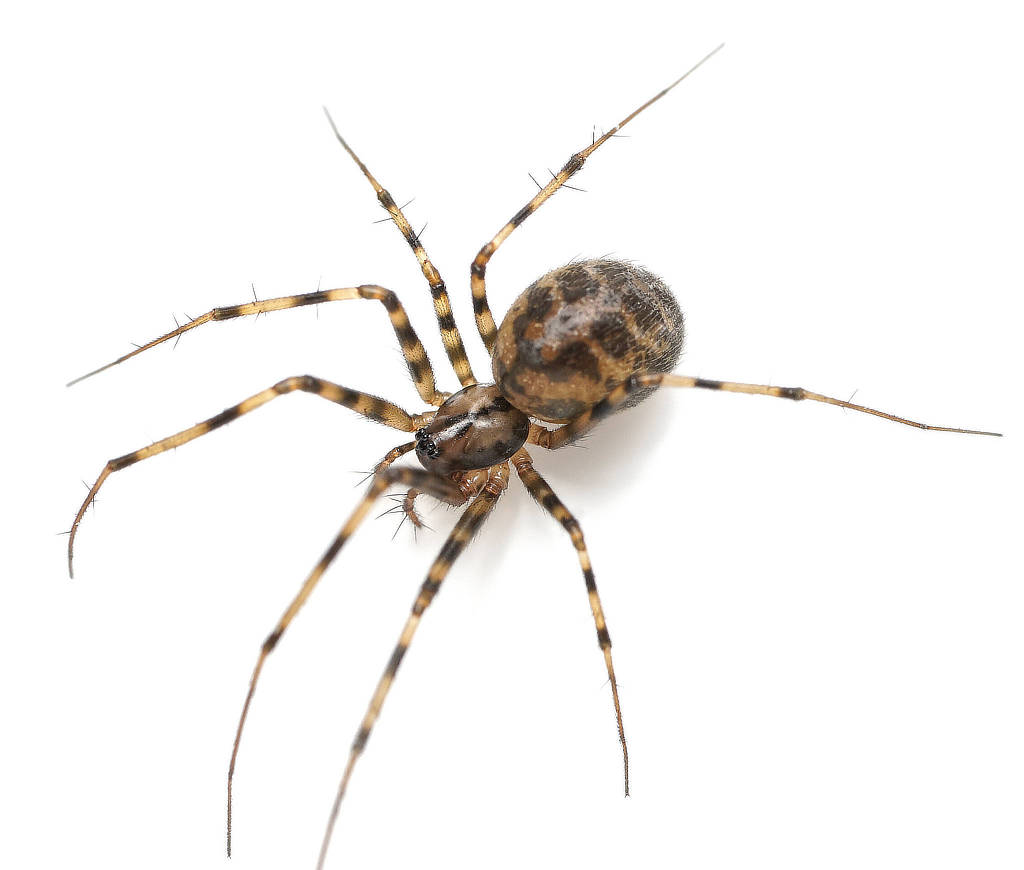
Last and very definitely least (size-wise!), Oonops domesticus paid me its triennial visit in October. I only seem to see this spider in my house every three years or so but it is always a welcome sight - one of my favourites. 


Monday, 28 March 2022

Old Big-Eyes is Back

 Quiz time! Which species of spider is this the natural habitat of? 

Habitat

One of them is Textrix denticulata, not particularly common in Leicestershire:

Textrix denticulata
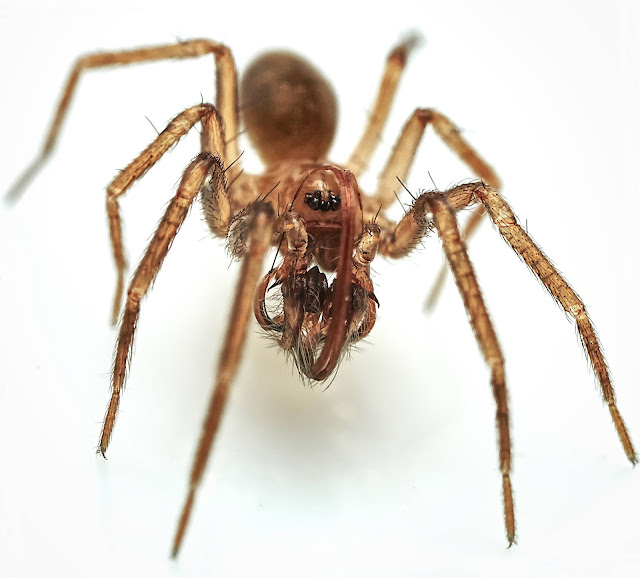
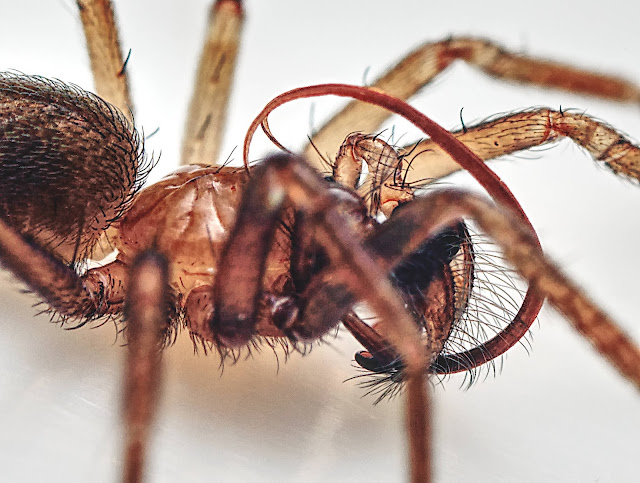
In January I was asked by the Charnwood Forest Landscape Partnership scheme if I could help refind the "Charnwood Spider", Mastigusa macrophthalma. This species was last recorded in Leicestershire 20 years ago, and on Charnwood 21 years ago. Rashly, I said yes, but bearing in mind some good arachnologists have been surveying on Charnwood in recent years, privately I had my doubts. For various reasons, I haven't been able to do much fieldwork yet this year, but recently I was able to revisit one of the last known Charwood sites for the species.

Mastigusa macrophthalma

Mastigusa macrophthalma

Mastigusa macrophthalma


Success :-)

The other interesting thing about this record is that the spider was associating with Formica lemani (thanks to Gavin Gamble and Matt Hamer for the ID) under the rock, which I have not seen listed as a known associate for this species elsewhere:

Formica lemani

I'm delighted to have been able to see and photograph this magnificant spider (now back under its home rock after a few photographs). However, I do worry a lot about the amount of disturbance and pressure on the site. My next move, having got my eye in, is to try and find new sites for the species, clinging to its ancient Charnwood home by its teeny tiny claws. 


Tuesday, 15 March 2022

Microscope Upgrade

My former stereo microscope (a GXM XTL3T101) has been my workhorse ever since I bought it. This is a mid-priced instrument and excellent value for money. One thing I have been finding however is that a high magnifications (40-45X) the quality of images dropped off compared with lower magnification. I have recently been able to trade-in my former microscope and upgrade to a GXM UltraZoom-3 stereo microscope: 


So what do I think of it? Well to be honest my initial hope was to do a bigger upgrade than this, but without paying Leica/Nikon/Olympus/Zeiss silly money. That proved to be difficult as I couldn't find anything suitable in the mid-priced - Russian oligarch price gap. The GXM UltraZoom-4 is a great instrument and closer to what I was hoping for, but sadly the working distance is too short, so I settled for the UltraZoom-3. 

After having a few days to use it, the GXM UltraZoom-3 is clearly an optical upgrade from the GXM XTL3T101, but perhaps not as mind-blowing as I was hoping for. Where it does score a big win is in the upper end of the magnification range (63x vs 45X on the XTL3T101). No only is the resolution better, but it is much brighter at the top end. This is particularly true of the trinocular light path to the camera, and I'm now able to use lower ISO settings and shorter exposures than before. The increased magnification also comes in handy - here's an illustration. A recent sample turned up the usual Tomocerid springtails. However, for the first time I was able to visualize the spines on the dens and identify the specimens as Tomocerus vulgaris without having to resort to using my compound microscope: 

Tomocerus vulgaris dens

That is an advantage over the GXM XTL3T101 and makes me feel I made the right decision with the upgrade.


Monday, 7 February 2022

Spider names - what do they mean?

Most spiders do not have common English names. I find it easier to remember the latin species name if I know what it means. 


Bathy - "deep"

Bathyphantes - Deep Weaver

Bathyphantes approximatus - "close to" - Similar Deep Weaver

Bathyphantes gracilis - Slender Deep Weaver

Bathyphantes parvulus - Small Deep Weaver

Bathyphantes setiger - Setiger's Deep Weaver


Leptos - "thin"

Lepthyphantes - Thin Weaver

Lepthyphantes leprosus - Skinny Thin Weaver

Lepthyphantes major - Greater Thin Weaver


Megalepthyphantes - Giant Thin Weaver

Megalepthyphantes collinus - Collin's Giant Thin Weaver

Megalepthyphantes nebulosus - Misty Giant Thin Weaver


Phantes - Greek, "weaver"


Segestria florentina - blanket or counterpane, a reference to the shape of its web outside the burrow, from Florence - Florence Blanket Spider.


Tenuis - "thin/slender"

Tenuiphantes - Slender Weaver

Tenuiphantes alacris - Brisk/Quick Slender Weaver

Tenuiphantes cristatus - Created Slender Weaver

Tenuiphantes flavipes - Yellow-footed Slender Weaver

Tenuiphantes nigrinus - Black Slender Weaver

Tenuiphantes zimmermanni - Zimmermann's Slender Weaver, after Walter Max Zimmermann (1892–1980)


Monday, 22 November 2021

BLUE+DECKER


After 22 months my trusty BLACK+DECKER GWC3600L20-GB eVac died. In the field on Friday, flicked the switch - nothing. Lots of fiddling, nothing. Completely dead. A completely dead lump of orange and black plastic electrical waste. I estimate I used it somewhere between 50-100 times, was careful always to dry it as fully as I could before putting it away. Is 22 months a reasonable lifespan? To be fair, B+D do have a 24 month warranty, but since I don't have all the original bits I don't think that would apply. Either way, it has turned up close to a dozen VC55 firsts, beasties I would never have found otherwise. After the woe, I ordered another one. At least I have some spares now, I just wish it was repairable.