Sunday, 17 November 2019

The "return" of Uloborus plumipes

Uloborus plumipes

Uloborus plumipes, also known as the Feather-legged Spider (derived from the Latin pluma "feather" and pes "foot"), or Garden Centre Spider, is a European species now widely distributed in greenhouses and garden centres worldwide. Believed to have been imported from The Netherlands on plants and first recorded in the UK in the 1990's, this species survives in greenhouses and buildings where the winter temperature is maintained above freezing. In this habitat it appears to play an effective role in controlling whitefly, but they are not commonly found in domestic houses. Although it is now widely distributed across the UK, they are cryptic and difficult to spot as they hang upside down motionlessly in their webs. Their horizontal webs and star-shaped egg sacs are much easier to find than the spiders themselves. Females grow up to 6mm and appear to vastly outnumber males, but this may be because the 4mm males are even more cryptic than the females. This species lacks venom glands and traps prey by entanglement in fuzzy, non-sticky cribellate silk.

The Garden Centre Spider was first recorded in VC55 (Leicestershire and Rutland) in 2001, ironically in a garden centre only half a mile from my home. It was subsequently recorded at Brooksby Agricultural College in Melton Mowbray, once more in a now-defunct Leicester garden centre, and finally in the plant section of a Homebase Superstore on 12/06/2006. The species has not been recorded in VC55 since that date, so, with half the roads and fields in the County underwater, I decided to go and do some fieldwork in warm garden centres. The logical place to start was the original location near my home. The only problem with that plan was that this garden centre no longer exists, having been replaced by a housing estate. However, before redevelopment, the owners moved the garden centre business to a new location in the County, so that's where I headed.

It took me approximately three and a half minutes to find the first one, naturally enough, an adult female. Webs were very much in evidence, and after a bit of search, I also managed to find a juvenile. Home again within the hour. One of the good things about being an Arachnologist is that it allows me to predict the future: if the weather stays this wet, more garden centre visits are in store :-)
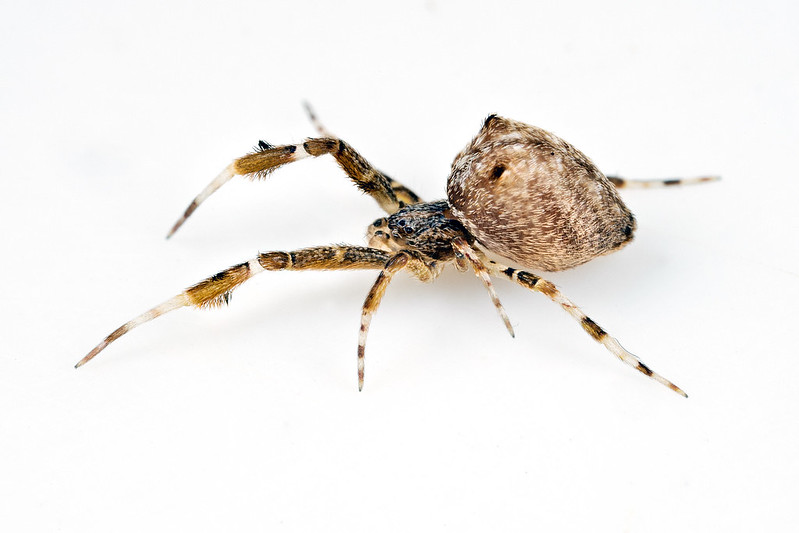
Uloborus plumipes


Sunday, 3 November 2019

Diplocephalus latifrons - why the long face?


"Being honest, I'd finished the earwigs and I was bored so I doodled a few crazy spider designs. I think this one looks cool though and I might make it."
God.

Diplocephalus latifrons - why the long face? There's a good reason why some male linyphiids have these wacky cephalic extensions. During mating, the male approaches the female from the front. Most male spiders use the front legs to try to hold up the female or her chelicerae and stop her biting him. In these spiders, the chelicerae fit into the sulcus (groove) on the cephalic hump, wedging them open and preventing her from sinking her fangs into him. But are female spiders really that dumb? No. The sulcus is rich in glandular tissue and the secretions are actually a form of nuptial gift. Matings where females do not receive these nuptial secretions are less likely to result in successful reproduction. Nice design!


Thursday, 31 October 2019

Spider Explosion!


click for larger images

Heavy rain (an understatement) during the last week has washed any remaining spiders off the foliage and the action is now all down in the leaf litter. It's been sift-and-sort all the way this week. I've examined leaf litter from four different sites and the number of Microneta viaria has exploded. I have found them as the predominant species at all the sites I have visited, and at one site, they are all I found! This has solved one mystery for me. For the past few months I have been finding immature specimens of a spider with a grey prosoma and orange opisthosoma I have not been able to identify:


It's now clear that these were immature Microneta viaria and now I can see why there were so many of them! Fortunately, they are easy to identify when mature. Both the male palps and female epigyne are characteristic and the prolateral spine on the inside of tibia1 is also helpful.


Epigyne

I think it's no accident that this has coincided with large numbers of springtails in the leaf litter (particularly Dicyrtomina saundersi) - food availability has spurred mass maturation.

Thursday, 24 October 2019

How to do biological recording

An interesting new preprint addresses an issue I've been concerned about for a while, how to control for recording effort in assessing how species are doing (Rapid assessment of the suitability of multi-species citizen science datasets for occupancy trend analysis: https://www.biorxiv.org/content/10.1101/813626v1).

The biggest volume of biological data is recorded by unstructured citizen science schemes. Because the data is collected in an essentially random way, many taxon experts are sceptical about the value of these schemes in accurately reflecting populations in the field. Although the statistics are complicated, the method of the new paper seeks to turn unstructured data into occurrence data, i.e. data where we can be sure (to any specified degree) of the presence or absence of a species in a given time period, or the absence of sufficient data to make a determination. The method to do this is to call each 1km grid square a recording site and to count the number of visits each year, one visit constituting one record by any person in a 24 hour period. From this it is possible to calculate the degree of confidence in the occurrence or absence of a species at the site. Ideally (for high confidence) there would be four or more visits from experienced recorders per site per year, but even in the absence of this, the method provides a way of turning the massive amount of unstructured biological recording data available into findings which are easier to interpret and to place confidence limits on.


(click for larger image)

Unsurprisingly, it turns out that butterflies and moths are the runaway winners, the East Midlands performs creditably, and species which get a lot of publicity do better than those for which there are only a handful of experts who can identify them. Nevertheless, if tools could be developed to enable easy utilisation of the method, this would present a valuable way forwards.


(click for larger image)


Note: R package "unmarked" is of relevance: https://cran.r-project.org/web/packages/unmarked/index.html

Thursday, 26 September 2019

Spiders on the Green

Cann, AJ (2019) Spiders on the Green. Natural History Section Newsletter, Leicester Literary & Philosophical Society, Autumn 2019.

Click for larger image:


Monday, 23 September 2019

Electric fields and ballooning in spiders


Morley, E.L., & Robert, D. (2018) Electric fields elicit ballooning in spiders. Current Biology, 28(14), 2324-2330. https://www.sciencedirect.com/science/article/pii/S0960982218306936

Tuesday, 17 September 2019

Fight!

Fight

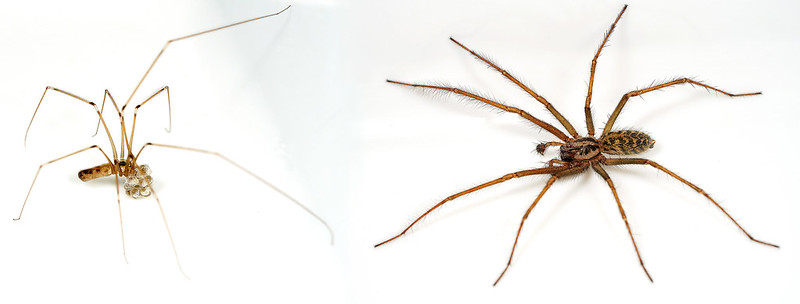
Had to separate these two last night - it wasn't going to end well (for the big guy).

Pholcus phalangioides vs. Eratigena (Tegenaria) duellica.

Monday, 16 September 2019

Enoplognatha latimana - a new species of spider for VC55

Cann, A.J. (2019) Enoplognatha latimana - a new species of spider for VC55. Leicestershire Entomological Society Newsletter 61, 4-5. 

Click for larger images: 


Wednesday, 11 September 2019

Talking about Neriene montana

Talking about Neriene montana

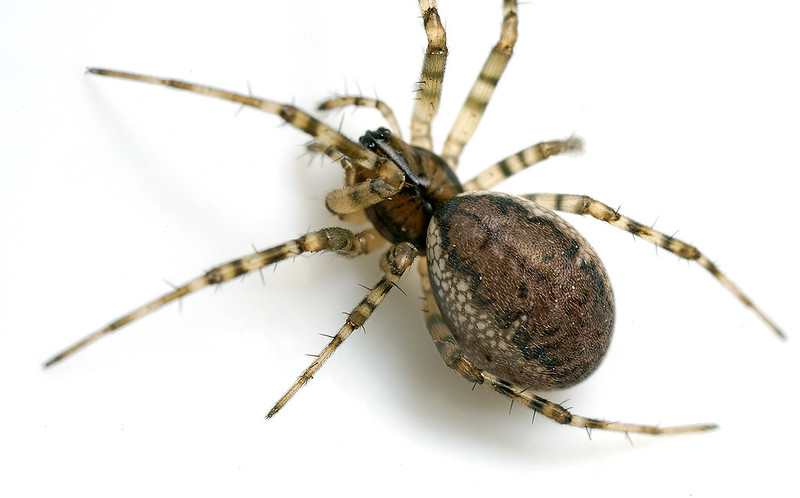
I led a wildlife walk this morning and found myself talking (in some detail :-) about spiders, specifically how Linyphiids hang from their hammock webs. This lady, somewhat surprisingly at eye level in a Scots Pine, illustrated my point nicely.

Neriene montana.

Neriene montana